Free photo estimate · No account
You don't notice it happening. That's the problem.
I'm Ben. I watched the top of my head thin for twenty years without ever knowing how far it had gone. You can't see a gradual change in your own mirror.
Two photos place it on the seven-stage scale. About a minute.
Find my stage- I
- II
- III
- IV
- V
- VI
- VII

The thinking behind Densy
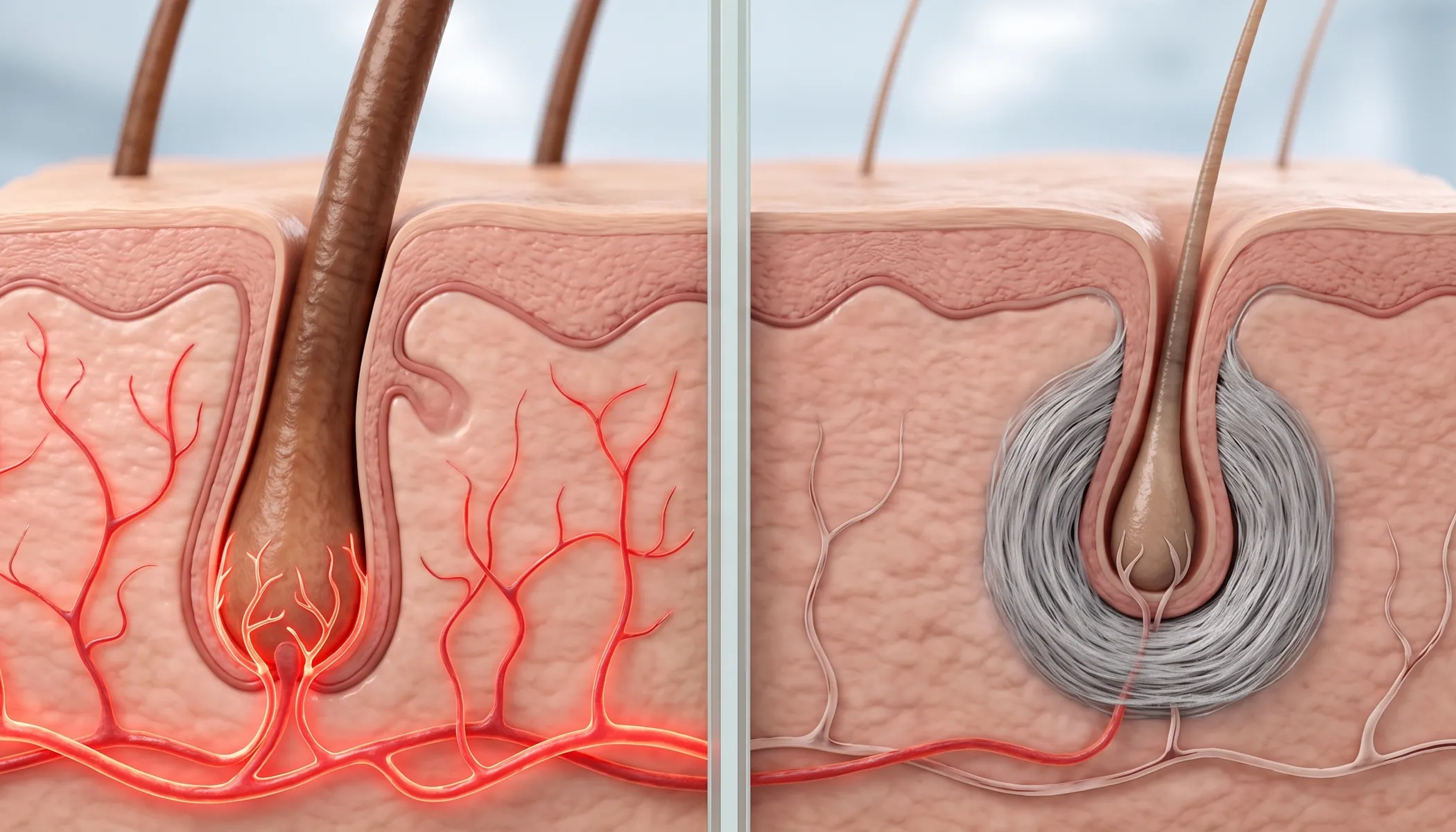
A follicle can be present and still produce less hair.
Densy's working model is that tissue around a root can stiffen over time, leaving a living follicle less able to produce a full hair. The checker estimates the pattern; it does not diagnose the cause.
You are trying to grow seeds in reinforced concrete.
Estimate your Norwood stage
After the estimate
A stage tells you how far it has gone. It cannot tell you whether your vertex is sterile or just dormant.
Two photos and a scale put you on a map. That is worth knowing, and it is where most people stop. They try something, wait six months, and have nothing to compare against. A Point Zero scan measures your scalp instead, so the next one can be compared to it.
Don't lose time and money at random, the way I did for years.
The free estimate above works from whatever light and distance you happened to have. A guided scan controls both, which is the only way two scans months apart can be compared.
- 01
Counts the fine hairs
Regrowth arrives as fine, pale hair long before it looks like hair. A scan separates that from full hairs and from empty pores, so the first real change shows months before a mirror would show it.
- 02
Zone by zone
One score for a whole head hides where things are moving. Progress is reported per area, so you can see which parts are responding and which are not.
- 03
Comparable
Same distance, same light, every time. That is what makes a scan months from now measurable against this one, instead of just a different photo.